Scope creep is like inviting ten friends to dinner and ending up hosting a block party. It starts small—“Can we just add this little feature?”—but before you know it, your development budget is exploding, timelines are melting, and engineers are scrambling. The real culprit? Poor requirements management. Especially, blurry lines between business needs and system functions.
Let’s fix that.
Start with the Basics: Business Requirements vs. Functional Requirements
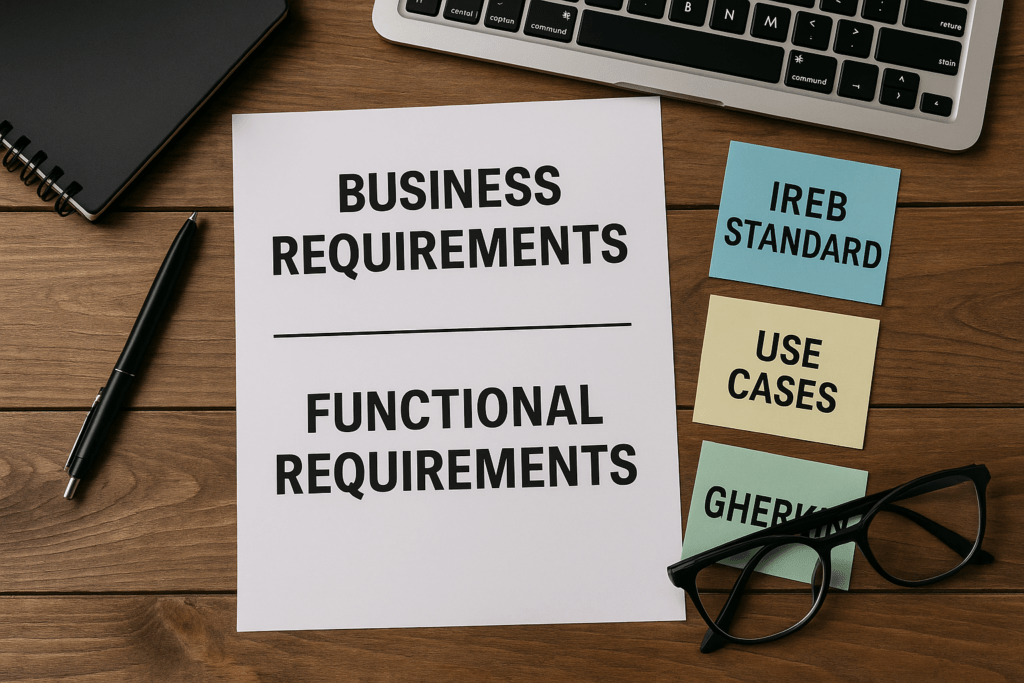
Think of business requirements as the “why” behind a project. They are high-level needs from the client, focused on value and outcomes: “We need to reduce customer churn,” or “We want to streamline our order processing.”
Functional requirements, on the other hand, are the “how.” They describe system behaviors: “The system must generate an invoice within 10 seconds,” or “The user can reset the password via email.” Engineers, testers, and designers live here—this is where the code gets its blueprint.
✅ In this article, we’ll zoom in on functional requirements—because from an engineering perspective, this is where scope creep takes root or dies.
How Software Development Companies Deliver Requirements to Clients
Delivering requirements is like handing over the ingredients list before baking a cake. Here are three common ways software teams present functional requirements:
IREB Standard (International Requirements Engineering Board) A formalized and certified structure that ensures completeness, clarity, and traceability. Perfect for enterprise projects with high risk.
Use Cases These describe how different types of users interact with the system. They’re intuitive and great for aligning with non-technical stakeholders.
Gherkin Syntax (Given/When/Then) A structured, human-readable format used in BDD (Behavior Driven Development). Developers love it, QA depends on it, and product owners understand it. Win-win-win.
Managing Requirements to Avoid Scope Creep: A Process
Let’s break down a practical process for managing requirements effectively, so the project doesn’t wander off into scope jungle.
1. Confirm Business Requirements
Before diving into features, align on the business goals. This stage is strategic—what problems are we solving? What metrics matter? What’s the “success” picture? This sets the north star.
2. Decompose Business Requirements into Functional Requirements
Here’s where the rubber meets the road. Break each business requirement into actionable, testable, and buildable chunks. It’s like turning “Make a pizza” into “Prepare dough, add sauce, sprinkle cheese, bake for 12 minutes.”
This step is critical. Many clients don’t want to dive too deep here. They might say, “I don’t care how you build it, just make it work.” But skipping the details here is like saying, “I don’t care how you fly the plane, just get me to Tokyo”—without knowing if it’s fueled, piloted, or even pointed in the right direction.
One time we work with a client who say “Please just build the dashboard fast, the filters is not important now.” Later, when the filtering didn’t work properly, it took 40% extra time to rebuild. Small misses become big rework.
3. Create Requirements Documentation
Use some tools to maintain a clear, evolving single source of truth. This documentation should:
Map every functional requirement to a business requirement
Be accessible and collaborative
Be version-controlled and regularly reviewed
How We Managed Scope Creep in a Logistics Platform
A logistics startup came to us with a request to “automate shipments.” That was the business requirement. Through workshops, we decomposed it into over 40 functional requirements: from warehouse management, route optimization, to API communication with customs.
The client initially resisted detailed decomposition. But once we showed them how a missed API validation could delay shipments by 3 days, they leaned in. We used Use Cases for tests, and some tool to delivery tracking. End result? On-time, under-budget delivery—and zero post-release fire drills.
Takeaways
1) Poor requirements management causes scope creep. 2) Clients skipping functional detail leads to delays, rework, or missed features. 3) Decomposing business needs into clear, testable functional requirements ensures traceable, predictable project execution. 4) Want to build smarter, not bigger? Start with better requirement management.
About author
I’m Karol Kordziński from Poland . I’m an analyst with a couple of years of experience. I’m the owner of ITGrowPartner where we help small- and medium-sized companies analyze projects. But mainly I’m the owner of Product Core Lab. Saas tool to manage a product in the whole Product Lifecycle. With this tool, you can explain your product and processes in a structural method. We introduce you to how to model software products step by step
We use cookies to ensure that we give you the best experience on our website. If you continue to use this site we will assume that you are happy with it.Ok


 I’m Karol Kordziński from Poland . I’m an analyst with a couple of years of experience. I’m the owner of ITGrowPartner where we help small- and medium-sized companies analyze projects. But mainly I’m the owner of Product Core Lab. Saas tool to manage a product in the whole Product Lifecycle. With this tool, you can explain your product and processes in a structural method. We introduce you to how to model software products step by step