Stop scope creep before it starts – confirmation in Discovery
Avoiding scope creep with confirmation. The real power of the discovery Phase
In software product development, the discovery phase is like drawing a map before a journey. But even the best map is useless if the travelers misunderstand where they’re going. Confirmation—that underestimated moment when everyone nods and says, “Yes, that’s exactly what we mean”—is the difference between shipping a successful product and wandering into the dreaded jungle of scope creep.
Let’s unpack how sharpening confirmation during discovery prevents requirements from growing wild and ensures smoother project execution.
Confirmation is the unsung hero of discovery
Too often, discovery workshops and stakeholder interviews end with assumptions masquerading as agreement. Everyone leaves the room “aligned,” but two weeks later, new requirements pop up like weeds in a neglected garden.
The solution isn’t more meetings—it’s better confirmation practices.
What is confirmation in discovery, really?
Confirmation is not just repeating requirements back to the client. It’s a deliberate process of validating understanding, documenting expectations, and ensuring clarity with repeatable, verifiable feedback loops.
This can include:
- Rephrasing requirements in plain language and asking stakeholders to confirm accuracy.
- Using visual tools like wireframes or workflow diagrams to validate interpretations.
- Creating mini use cases to test if the client truly meant what they said.
- Having clients or stakeholders sign off on draft requirements documentation, even informally.
Think of confirmation like a “mirror check.” Just like you wouldn’t start driving before checking your mirrors, you shouldn’t start building before confirming what everyone sees.
The “Email Notifications” misunderstanding
In a recent B2B platform build, a stakeholder casually mentioned wanting “email notifications” for user actions. The team documented it and moved on.
Weeks later, during UAT, the stakeholder said, “Wait, I meant real-time SMS for critical actions, not just emails.”
The team had to backtrack, costing delays and budget.
Had they used a simple confirmation exercise—like summarizing this requirement and asking, “Do you mean email only? Or is there another channel involved?”—the misunderstanding would’ve surfaced early.
Confirmation is also about communication skills
Here’s where communication skills come into play. As Product Owners and Business Analysts, your job is to translate business vision into actionable software requirements.
This means:
- Asking “Why?” behind each feature.
- Listening not just to what is said, but what is unsaid.
- Watching body language and noticing hesitation when someone says “Yes” too quickly.
- Knowing when to rephrase a requirement in simpler terms.
One technique that helps is the 3X Confirmation Rule:
- Confirm verbally in the meeting.
- Confirm again in a follow-up summary email.
- Confirm once more during documentation walkthrough.
It might feels like overkill, but in reality, it’s risk prevention.
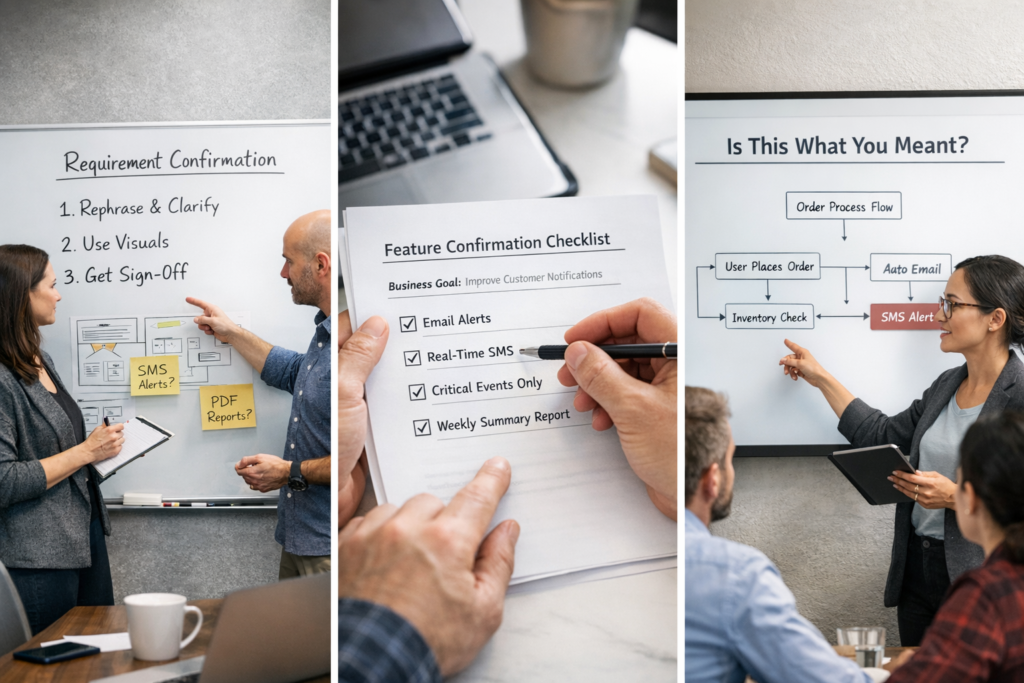
Confirming Requirements in a Complex CRM Upgrade
In a CRM upgrade project for a global sales team, we introduced a Requirement Confirmation Board during discovery. Every requirement had:
- A business goal,
- A responsible stakeholder,
- A confirmation checklist,
- And a visual example.
This allowed the Product Owner to present back each feature as a mini contract—not legally, but psychologically.
When one stakeholder asked for a “custom report builder”, we drilled down: “What filters? How often? What export format?” Turns out, they only needed a weekly auto-generated PDF, not a full builder.
That saved the team 4 weeks of unnecessary dev effort.
Documentation is only as good as confirmation
Good documentation is key in software requirements management, but it’s only useful if it reflects confirmed understanding.

Don’t let the discovery phase become a note-taking session. Turn it into a mutual validation process. Treat your documentation as a shared agreement, not just internal notes.
Confirm before you build
Scope creep is rarely about bad intentions. It’s usually about bad assumptions.
That’s why improving confirmation during the discovery phase is one of the most valuable habits a software team can build. It’s proactive, not reactive. It’s communication in action. It’s your first line of defense.

Don’t just gather requirements—confirm them like a contract. Use diagrams, paraphrasing, simple test cases, and feedback loops. And remember: The cost of confirmation is always less than the cost of correction.
About author
 I’m Karol Kordziński from Poland . I’m an analyst with a couple of years of experience. I’m the owner of ITGrowPartner where we help small- and medium-sized companies analyze projects. But mainly I’m the owner of Product Core Lab. Saas tool to manage a product in the whole Product Lifecycle. With this tool, you can explain your product and processes in a structural method. We introduce you to how to model software products step by step