What Is Layered Architecture? Basics Every Product Owner Should Know
Basics of Layered Architecture

When a software product starts small, its structure often feels simple. A few screens, several business rules, a database, and some integrations may be enough to deliver the first version.
Then the product grows.
More customers arrive. New features are added. Business rules become more complex. Different developers work on the same codebase. Integrations multiply. Suddenly, a small change in one place creates unexpected problems somewhere else.
This is where Layered Architecture becomes useful.
Layered Architecture is one of the most common ways to organize software systems. Its main idea is simple: instead of building the application as one large block, we divide it into logical layers. Each layer has a clear responsibility and communicates with other layers in a controlled way.
For Product Owners, Business Analysts, and Project Managers, understanding this concept is useful even if you never write code. Architecture influences development speed, cost, maintainability, technical risk, and the ability to introduce new features.
Think about Layered Architecture like a well-organized restaurant. Customers do not walk into the kitchen and start preparing food. Waiters collect orders, chefs prepare meals, and storage areas provide ingredients. Each part has its own responsibility. The restaurant works because these responsibilities are separated but connected.
Software can work in a similar way.
What Is Layered Architecture?
Point: Layered Architecture separates a software application into groups of responsibilities.
Explanation: Instead of mixing user interfaces, business rules, database queries, and external integrations in the same place, developers organize them into separate layers. Each layer solves a particular type of problem.
A typical application may contain four main layers:
- Presentation Layer
- Business or Application Layer
- Domain Layer
- Data Access or Infrastructure Layer
The exact names depend on the organization and technology, but the principle remains similar.
Example: Imagine an online banking application. A customer clicks the “Transfer Money” button. The screen collects information about the recipient and amount. Another part of the system checks whether the transfer is allowed. Another part updates account information in the database.
Each responsibility belongs to a different layer.
Link: By separating these responsibilities, teams can understand and change individual parts of the application more easily.
1. Presentation Layer: The Front Door of the Application
The Presentation Layer is responsible for communication with the user or another external client.
It can include a website, mobile application, desktop interface, or API.
Think of this layer as the reception desk in a hotel. A guest talks to the receptionist, not directly to housekeeping, accounting, or the kitchen. The receptionist collects the request and passes it to the right part of the organization.

The Presentation Layer works in a similar way.
For example, imagine an e-commerce platform where a customer wants to create an order.
The Presentation Layer may:
- display the shopping cart,
- collect the delivery address,
- validate whether required fields are completed,
- send the order request to another layer,
- display the result to the customer.
However, it should normally not decide important business questions such as whether a customer qualifies for a discount.
That decision belongs somewhere else.
Keeping complex business logic away from the user interface becomes especially important when a product has several interfaces. The same business rules may need to work on a website, a mobile application, and through an API.
2. Business or Application Layer: The Traffic Controller
The Business or Application Layer coordinates what should happen when the system receives a request.
Think about an airport control tower.
The controller does not fly the planes. It coordinates their movements and makes sure different actions happen in the correct order.

The application layer often performs a similar role.
Suppose a customer confirms an online order.
The application may need to:
- check the shopping cart,
- calculate the final price,
- validate availability,
- create the order,
- initiate payment,
- send a confirmation.
The Application Layer coordinates this process.
For a Business Analyst, this is an important area because many business processes eventually become application flows.
A requirement such as:
“When a customer places an order, the system should verify inventory before accepting payment.”
looks simple from a business perspective.
Architecturally, however, the application may need to coordinate several components and layers to make that requirement work correctly.
Understanding this relationship helps analysts write better requirements and ask better questions during refinement.
3. Domain Layer: Where Business Knowledge Lives
The Domain Layer represents the core rules and concepts of the business.
If software were a company, the Domain Layer would be the company’s rulebook and experienced employees.

It knows what is allowed, what is not allowed, and how important business concepts behave.
For example, an insurance application may contain rules such as:
- a policy must have an active customer,
- a claim cannot exceed certain limits,
- some customers qualify for special conditions,
- specific products are available only in selected countries.
These rules should not normally depend on whether the customer uses an iPhone, a browser, or an API.
They represent the business itself.
That separation can become extremely valuable.
Imagine that your company changes the user interface completely. If the business rules are properly separated, developers may replace large parts of the Presentation Layer without rebuilding all business logic.
This is one reason good architecture can protect a product investment.
The development team sometimes need to change several components before one business rule can be introduced successfully.
That sentence contains an intentional language mistake, explained at the end of the article.
4. Data Access and Infrastructure Layer: The Storage and Connections
The Infrastructure Layer handles technical communication with databases and external systems.
If the Domain Layer represents the company’s knowledge, Infrastructure represents the roads, warehouses, electricity, and telephone lines that allow the company to operate.

This layer may interact with:
- SQL databases,
- cloud storage,
- payment providers,
- email services,
- message queues,
- external APIs,
- authentication providers,
- reporting systems.
For example, the business logic may decide that a new customer account should be created.
The Infrastructure Layer handles the technical details of storing that account.
This distinction matters because business rules can remain relatively stable while technologies change.
A company may move from one database technology to another. It may replace a payment provider or migrate infrastructure to another cloud platform.
A well-designed architecture tries to limit how much those technical changes affect the rest of the product.
How the Layers Work Together
Consider a simple example.
A customer wants to purchase a subscription.
The request may move through the system like this:
Presentation Layer → Application Layer → Domain Layer → Infrastructure Layer
The customer clicks “Subscribe.”
The Presentation Layer receives the request.
The Application Layer coordinates the subscription process.
The Domain Layer checks important rules, such as whether the selected subscription is available to the customer.
The Infrastructure Layer saves the subscription and communicates with the payment provider.
Then the result travels back to the user.
The important principle is that each layer knows what it needs to know, but ideally does not take responsibility for everything.
A good restaurant waiter does not leave the dining room, calculate the company’s taxes, repair the refrigerator, and then cook the meal.
Software components should also avoid becoming responsible for too many unrelated tasks.
Why Layered Architecture Matters for Product Teams
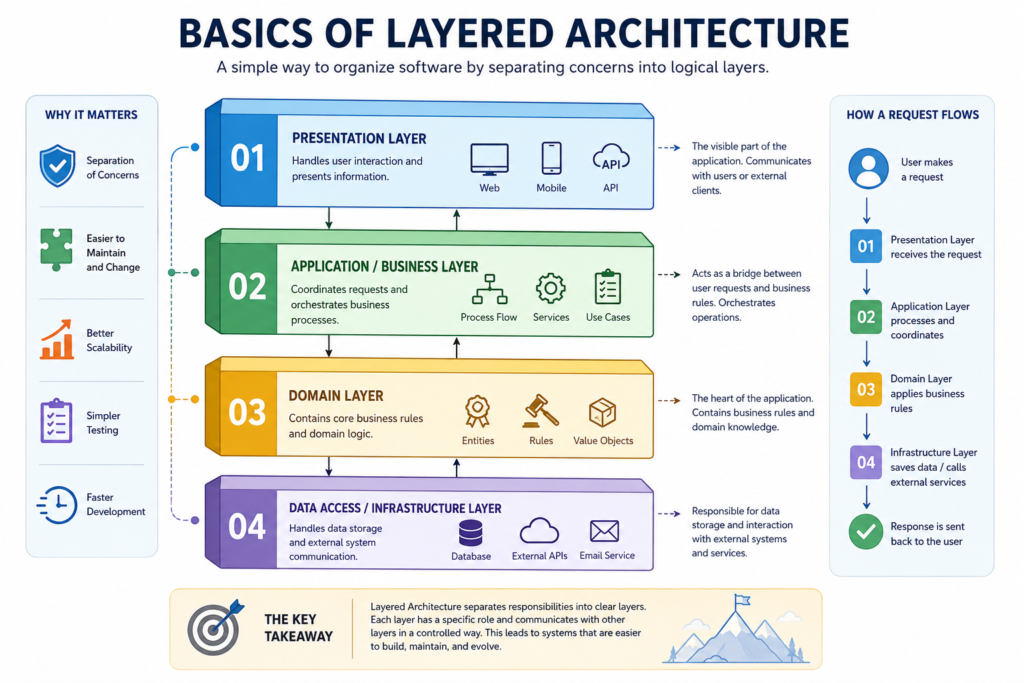
Layered Architecture is not only a technical topic.
Architecture affects product management decisions.
Consider a request that sounds small:
“Add another delivery provider.”
From a Product Owner’s perspective, this might appear to be one integration.
But the technical impact depends heavily on how the existing application is structured.
If delivery logic is separated from core business rules, adding another provider may be relatively straightforward.
If provider-specific logic is scattered across dozens of components, the change can become expensive and risky.
Architecture therefore influences:
- development estimates,
- release planning,
- technical debt,
- defect rates,
- testing effort,
- scalability,
- integration costs,
- future product flexibility.
This is why technical architecture discussions can matter during roadmap planning.
A feature is not only a visible customer capability. It also becomes part of a growing technical system.
The Main Advantage: Separation of Concerns
Point: The biggest strength of Layered Architecture is clear separation of responsibilities.
Imagine an office where every employee handles sales, accounting, customer service, recruitment, and IT support.
At first, this might seem flexible.
As the company grows, it becomes chaos.
Software systems experience a similar problem when responsibilities are mixed.
Separating concerns makes the system easier to understand.
A developer investigating a pricing calculation knows approximately where to look. A developer changing database technology does not necessarily need to redesign the customer interface.
This can also make testing easier because individual parts of the system can often be tested separately.
Layered Architecture Does Not Automatically Mean Good Architecture
Creating folders called “Presentation,” “Business,” and “Database” does not automatically create good architecture.
Teams can still build strong dependencies between layers.
For example, imagine that every business rule directly depends on a particular database structure.
Technically, layers may exist, but changing the database could still affect the whole application.
It is similar to building a house with separate rooms but connecting all the electrical wires, water pipes, and furniture together. The rooms look separate, but changing one area still damages everything else.
The goal is not simply to create layers.
The goal is to create clear boundaries and responsibilities.
Growing an Order Management Platform
Consider a company that operates an order management platform.
Originally, it supports one web store and one payment provider.
After one year, the business wants to expand.
The roadmap includes:
- a mobile application,
- marketplace integrations,
- three new payment providers,
- multiple shipping companies,
- country-specific pricing rules.
Without clear architectural separation, every new integration may require changes across large parts of the system.
The Product Owner notices that delivery estimates are growing. A “small integration” that previously required several days now requires multiple development sprints.
The team decides to restructure parts of the system.
Business rules are separated from external integrations. Payment providers receive dedicated infrastructure components. Application services coordinate orders without depending directly on specific providers.
Several months later, the company wants to introduce another payment provider.
Instead of modifying the entire ordering process, developers mostly implement the new infrastructure integration and connect it to the existing application flow.
This is where Layered Architecture delivers measurable product value.
The benefit is not simply “cleaner code.”
The benefit is lower change cost, better predictability, and more flexibility when the product grows.
For organizations managing mature software products, architecture reviews can therefore become an important part of roadmap and technical-debt planning.
When Layered Architecture Works Well
Layered Architecture can be a strong choice for many business applications.
It is especially useful when:
- the application has clear business processes,
- business rules are important,
- several developers work on the product,
- the system is expected to evolve for years,
- maintainability matters,
- different interfaces may use the same business logic.
However, architecture should always match the problem.
A tiny prototype probably does not need an elaborate five-layer structure.
Building unnecessary architecture is like constructing a six-level parking garage for a house with one car.
Good architecture should reduce complexity, not create complexity simply because a diagram looks professional.
What Product Owners and Business Analysts Should Ask
You do not need to become a software architect to participate in architecture discussions.
A few practical questions can reveal a lot:
- Where are the important business rules implemented?
- What happens if we replace this external provider?
- Can the same business logic support both web and mobile applications?
- Which parts of the system will change if this requirement changes?
- Are business rules mixed with database or interface logic?
- Is technical debt making future features more expensive?
- Can individual layers be tested independently?
These questions connect technical decisions with business outcomes.
Instead of asking only, “How many days will this feature take?” teams can also ask, “What makes this feature expensive to change?”
That second question often leads to more valuable conversations.
Takeaways
- Layered Architecture is fundamentally about separation.
- The interface communicates with users.
- The application layer coordinates processes.
- The domain layer protects business rules.
- The infrastructure layer communicates with databases and external systems.
- Together, these layers create boundaries that can make software easier to understand, test, change, and maintain.
- For Product Owners, Business Analysts, and Project Managers, the important lesson is not learning every architectural pattern.
- The important lesson is understanding that software structure affects business agility.
- Think about architecture like the foundation and internal layout of a building.
- Customers may never see the pipes, electrical systems, or structural beams. But when the company wants to add another floor, move a wall, or expand the building, those invisible decisions suddenly matter.
- Software architecture works the same way.
- Good architecture does not guarantee a successful product.
- But as a product grows, it can make the difference between a system that supports change and a system that fights against every new requirement.
About author
 I’m Karol Kordziński from Poland . I’m an analyst with a couple of years of experience. I’m the owner of ITGrowPartner where we help small- and medium-sized companies analyze projects. But mainly I’m the owner of Product Core Lab. Saas tool to manage a product in the whole Product Lifecycle. With this tool, you can explain your product and processes in a structural method. We introduce you to how to model software products step by step